Long before modern shipping connected the continents, sailors were already crossing the Indian Ocean between Africa, Arabia, India and Southeast Asia. These journeys created a vast maritime network linking communities that were separated by thousands of miles of open water. For centuries, the ocean carried not only valuable goods, but also languages, religions, technologies and people.
The Indian Ocean was not simply a difficult stretch of water standing between distant civilizations. Sailors gradually learned to work with seasonal winds and ocean currents, making long-distance voyages more predictable. The monsoon system became one of the most important forces shaping life around the ocean, allowing ships to travel in one direction during one season and return when the winds changed.



This created a distinctive rhythm for maritime trade. A merchant arriving at a foreign port might have to remain there for weeks or even months while waiting for the right winds. That long wait gave traders opportunities to establish relationships with local communities, negotiate new deals and learn about markets beyond their original destinations.
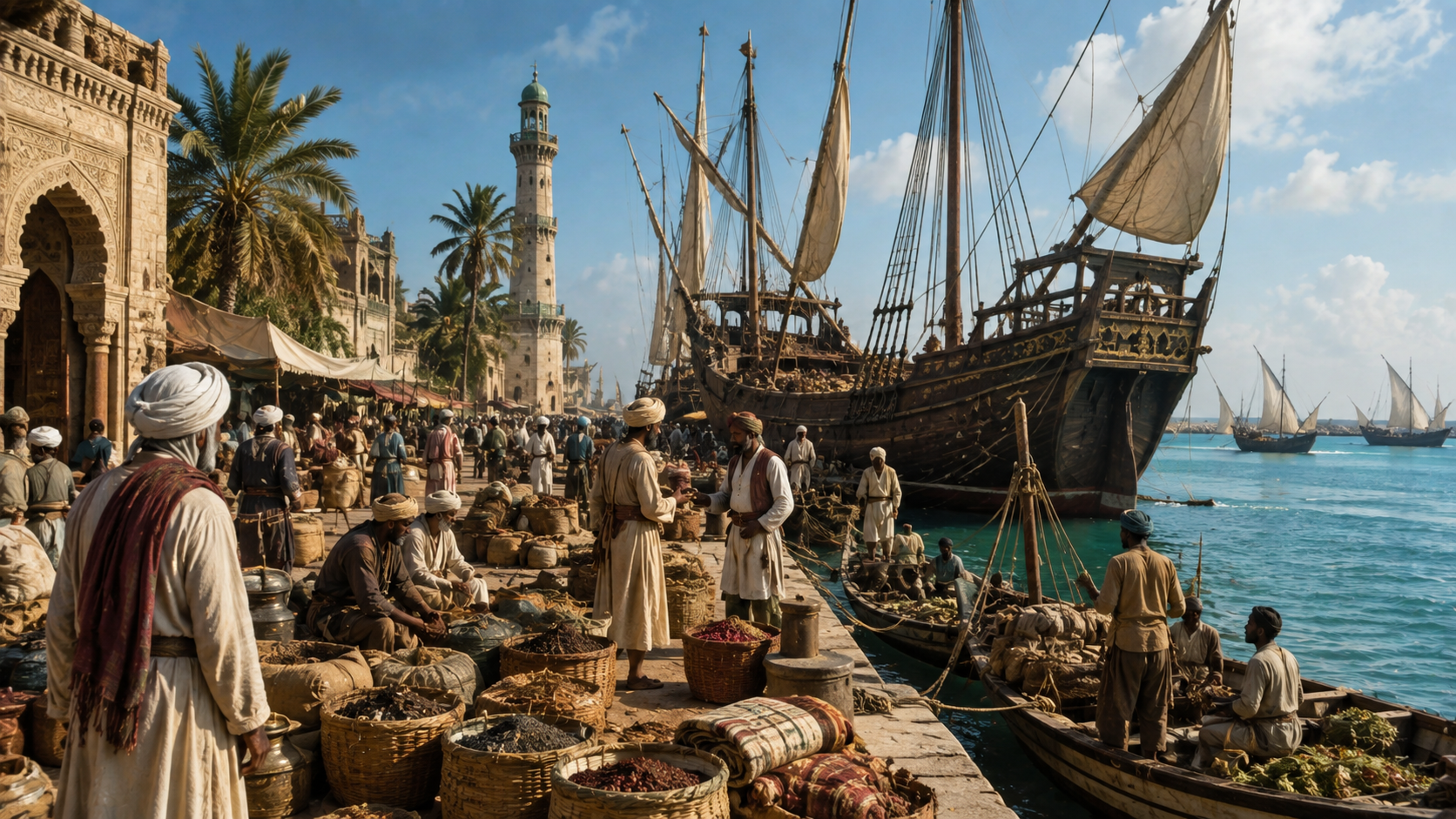
South Asia occupied a particularly important position in this maritime world. Indian ports connected inland producers with merchants arriving from Arabia, Persia, East Africa and Southeast Asia. Textiles, spices, precious stones and other valuable products moved through these ports before continuing toward markets scattered around the ocean.
The Arabian Peninsula and Persian Gulf formed another major center of maritime commerce. Merchants operating from these regions connected the Indian Ocean with the Red Sea and markets farther west. Goods arriving from India and Southeast Asia could therefore continue toward the Mediterranean, creating commercial chains that stretched across much of the ancient world.
The eastern coast of Africa was also deeply involved in this network. Coastal settlements exchanged African products for goods arriving from Arabia, Persia and India, creating prosperous communities along the shoreline. Over time, these connections contributed to the development of distinctive coastal cultures shaped by African, Arab, Persian and South Asian influences.
Southeast Asia occupied another crucial position because ships traveling between the Indian subcontinent and China often passed through its waters. Local rulers could gain considerable wealth by controlling ports, supplying visiting ships and taxing commercial activity. Some coastal kingdoms grew powerful precisely because they understood the value of their position within this wider maritime system.
The Strait of Malacca became especially important because of its location between the Indian Ocean and the South China Sea. Ships could use the passage to avoid longer journeys around the Malay Peninsula, making nearby ports attractive places to rest, trade and resupply. Control over these waters could therefore provide both commercial wealth and political influence.
Merchants did not always return home after completing their business. Some settled permanently in foreign ports, married into local families and established communities of their own. These settlements created new cultural connections that could survive for generations, even when political relationships between different kingdoms changed.
Religion traveled across the ocean alongside merchants. Buddhist traditions moved through maritime connections between South Asia and Southeast Asia, while Islam later expanded through commercial networks linking Arabia, India and the Malay world. Religious change often developed gradually through relationships between traders, local rulers and coastal communities.
Languages followed a similar path. Merchants needed practical ways to communicate across cultural boundaries, particularly in busy ports where people from several regions met every day. Trade languages and shared commercial terms developed through repeated contact, leaving linguistic traces that remain visible in many coastal societies.
The movement of knowledge was just as important as the movement of merchandise. Sailors needed detailed knowledge of winds, currents, coastlines and stars to cross open water safely. Navigation techniques developed in different parts of the Indian Ocean were shared, adapted and improved as sailors encountered new routes and unfamiliar seas.
Shipbuilding also reflected this long history of exchange. Different communities developed vessels suited to local waters, cargoes and sailing conditions, while builders borrowed useful ideas from other maritime traditions. A ship traveling between distant ports was therefore often the product of generations of accumulated knowledge rather than a single technological tradition.
The ocean was never completely safe. Pirates, storms, political conflicts and poorly understood coastlines could turn a profitable voyage into a disaster. Merchants depended on rulers who could provide protection, maintain ports and keep important waterways open, making political power closely connected with maritime commerce.
No single empire controlled the entire Indian Ocean for long periods. Political influence shifted between different kingdoms and trading centers as rulers gained or lost control of strategic ports. Merchants adapted to these changes by changing routes, finding new markets and building relationships with whichever authorities controlled the coastline.
The importance of the Indian Ocean continued to grow as maritime trade became increasingly sophisticated. By the time European powers began entering these waters in search of Asian wealth, they encountered an established commercial world rather than an untouched ocean. The routes they attempted to control had already been shaped by centuries of movement between Africa, Arabia, South Asia and Southeast Asia.